It’s been a minute.
I’ve been wrapping up my degree at WGU recently, and I’ve been meaning to sit down and write about it; not just the checkbox of “finished,” but what I actually did along the way. This wasn’t a passive degree. If anything, it reinforced that I’m still very much a network engineer at heart, even while technically enrolled in a general IT program (BSIT).
Still a Network Engineer (Just With Homework)
Most of my time at WGU ended up orbiting around networking concepts, intentionally or not.
At work, I’ve been involved in network engineering, and that carried directly into my coursework. Instead of treating assignments like academic exercises, I used them as an excuse to go deeper on things I actually care about: control planes, optics, Layer 2, and how real systems behave under pressure.
Two projects stand out.
VXLAN-EVPN Presentation (Excellence Award)
One of my favorite assignments was delivering an oral presentation to stakeholders on VXLAN-EVPN.
Not just “what VXLAN is,” but:
- why
EVPN as a control planeactually matters - how it replaces
flood-and-learn - how
BGPbecomes the distribution mechanism for MAC/IP reachability - what this means for
scale and multi-tenancy
I approached it like I would at work: clear problem framing, architecture diagrams instead of buzzwords, and honest tradeoffs between complexity and control. Most importantly, I focused on what actually breaks.
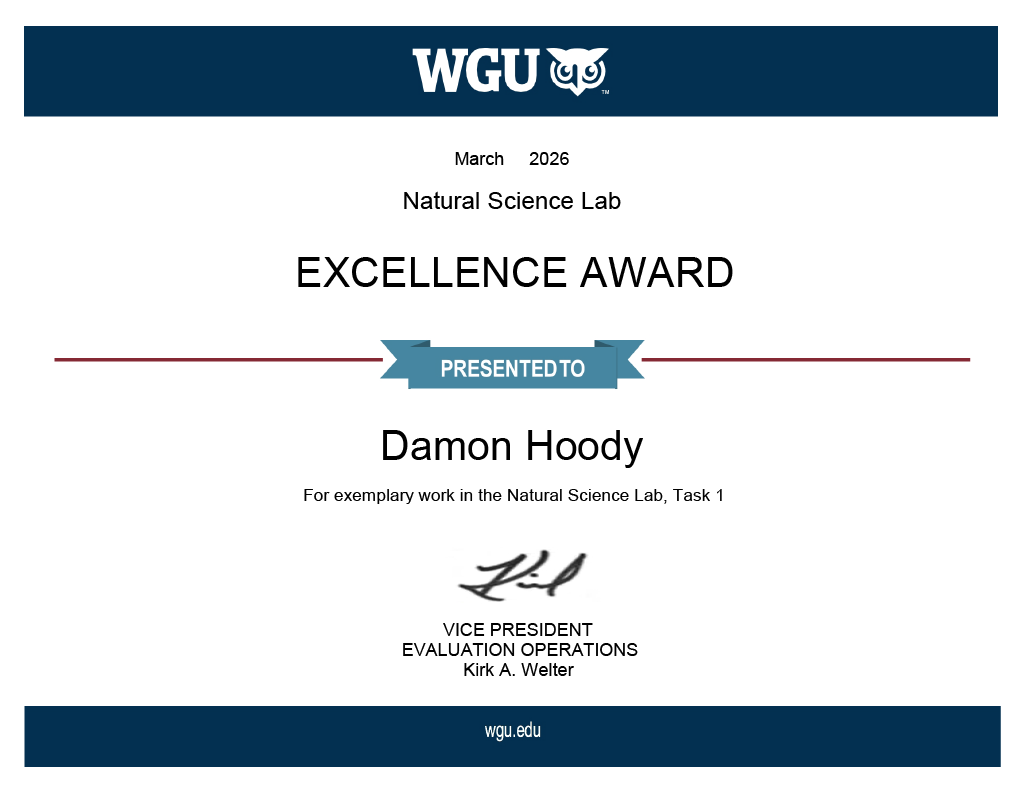
That assignment ended up earning an Excellence Award, which was great to see. More importantly, it validated that going deep instead of wide is still the right move.
Fiber Radius Mandrel Lab (Excellence Award)
The second Excellence Award came from something much more physical, a fiber optic bend radius / mandrel lab.
I enjoyed this one because it wasn’t abstract:
- measuring signal attenuation under different bend conditions
- observing real signal degradation instead of just reading about it
- understanding why bend radius specs actually matter in production environments
It’s one thing to learn signals attenuate from wear.
It’s another to watch the signals fall apart.
Again, another Excellence Award, but more importantly, it reinforced something I already knew:
the physical layer matters, and ignoring it will absolutely burn you.
Certifications Along the Way
WGU also pushed me through a few certifications:
LPI Linux EssentialsAWS Cloud PractitionerITIL v4 Foundations
Each of these filled in different gaps.
Linux Essentials reinforced fundamentals I use constantly but rarely formalize. AWS helped connect infrastructure concepts to cloud abstractions. ITIL gave me a better understanding of why change management exists, even if I still argue with it.
TKO: Rebuilding a Dead Game’s Network Stack
Outside of the structured coursework, the most meaningful project I worked on was for my Web Development Applications (C777) course:
This is a Python-based server emulator for Titanic KungFu Offensive, a discontinued Cartoon Network Flash game that originally ran on SmartFoxServer.
What started as a web development project turned into a flash & network reverse engineering effort.
Key pieces I rebuilt:
- Flash policy server
- SmartFox TCP socket emulation
- BlueBox HTTP tunneling
- Lobby, matchmaking, and session flow
- Server-authoritative game simulation
- Packet reconstruction from decompiled ActionScript
This wasn’t just about getting it to run. It involved reverse engineering packet formats, reconstructing timing behavior, making the server authoritative, and fixing edge cases that only show up mid-match.
Basically, real networking problems, just inside a Flash project.
The repo isn’t public yet, but here’s the upstream:
There’s also an active community we’ve been building around it:
700k Views Later
At some point, my project was recognized on Twitter.
It ended up pulling around 700k views, which I didn’t expect.
https://x.com/BenTenNews/status/2035921797988642831?s=20
I think it resonated because it’s not often you see legacy infrastructure brought back to life like this, especially with Flash being abandoned half a decade ago.
It was a good reminder that good work still gets attention when it’s visible.
Community
Outside of work and school, I’ve been spending more time engaging with the local tech community.
I’ve been attending monthly Cleveland Tech Breakfast meetups, which has been a great way to stay connected with other engineers, share what I’ve been working on, and hear what others are building.
It’s easy to get heads down in projects; having a space to step back and talk technology has been valuable, and it’s pushed me to stay engaged beyond just my own work.
What WGU Has Done For Me
WGU didn’t turn me into a network engineer; I already was one, even if not yet in title.
What it did do:
- forced structure around things I might have otherwise skipped
- pushed me to document and present ideas clearly
- gave me an excuse to formalize knowledge I built informally
- occasionally made me step outside my comfort zone
The biggest takeaway?
I never stopped doing engineering while earning the degree.
If anything, I doubled down on it:
- VXLAN/EVPN deep dives
- physical layer validation
- protocol emulation
- network automation
That’s the part I’m most proud of.
What’s Next
More of the same.
- Keep pushing deeper into network architecture
- Focus on CCNP ENCOR after graduation
- Keep building things (including resurrecting dead games)
- Keep bridging the gap between academic IT and real systems
And probably:
- make the TKO repo public once it’s a bit cleaner
Thanks for reading, and God bless.